To delo je na voljo pod pogoji slovenske licence Creative Commons 2.5:
priznanje avtorstva - nekomercialno - deljenje pod enakimi pogoji.
Celotna licenca je na voljo na spletu na naslovu http://creativecommons.org/licenses/by-nc-sa/2.5/si/. V skladu s to licenco je dovoljeno vsakemu uporabniku delo razmnoževati, distribuirati, javno priobčevati, dajati v najem in tudi predelovati, vendar samo v nekomercialne namene in ob pogoju, da navede avtorja oziroma avtorje in izdajatelja tega dela. Če uporabnik delo predela, kar pomeni, da ga spremeni, preoblikuje, prevede ali uporabi to delo v svojem delu, lahko predelavo dela ponudi na voljo le pod pogoji, ki so enaki pogojem iz te licence oziroma pod enako licenco.

Navodila
Now, click two adjectives that don't match the personality type.
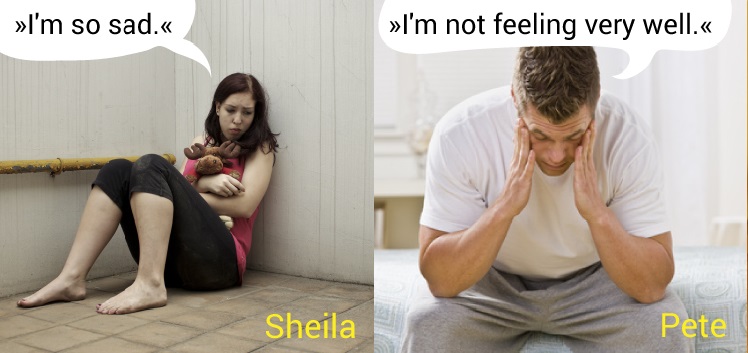
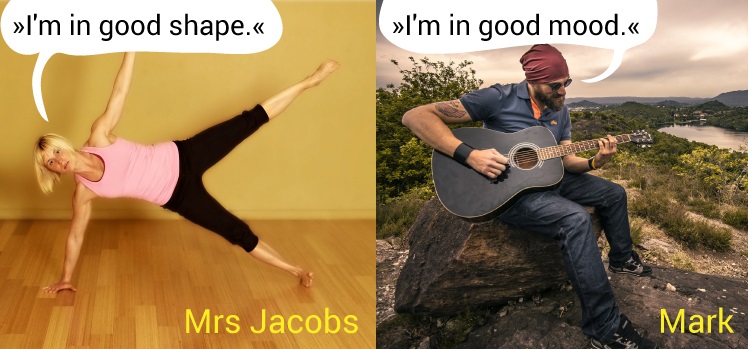
Choose one of the personality types that matches you best. Discuss good and bad traits and how to ease the features you're not very proud of. Finally, complete the idioms below with their names.
Mark
is a happy camper.
Shiela
looks down in the dumps. MrsJacobs
is as fit as a fiddle. Pete
is looking a bit under the weather.
Here is the first part of the text We're One of a Kind. Read it carefully and choose the articles that best complete the text.
We're One of a Kind
People are amazing beings. We all are humans with a mind, thoughts, and feelings - yet there are traits that make us one of
{a;an;the}
kind. No two people are truly alike, not even identical twins because one can be
{a;an;the}
happy camper and the other always looking down in the dumps. This is what we call personality,
{the;a;an}
combination of characteristics and qualities that form our unique and distinctive character. It’s
{the;a;an}
pattern of our behavior, feelings, and thoughts, it’s how we perceive things and react to situations.
People have always been intrigued by human personality. In ancient times, it was believed that all people could be classified into four personality types according to their body fluids (blood, yellow bile, black bile, and phlegm). Today, we know that such a grouping is not so straightforward. Modern psychologists tend to use
{the;a;an}
lexical approach, meaning they look at
{the;a;an}
words we use when describing someone’s personality. We notice people’s specific characteristics and choose words that best describe this distinctiveness, and we point out
{the;an;a}
extremes, but not so much
{the;a;an}
averages.
Choose the best answer to complete the statement.
Each person
{is_unique;has_a_twin;a_copy_of_someone}
.
Grouping according to body fluids is
{complicated;easy;undemanding}
.
Modern psychologists take a look at
{which_words_we_use;what_characteristics_we_mention;how_good_we_are_at_describing}
.
GRAMMAR LOG
Articles
Indefinite articles a/an
There are three articles in the English language. A and an are indefinite articles, we place them with singular nouns the first time we refer to a person, object, or animal. A is used with nouns (or adjectives before nouns) starting with a consonant (a student), while an is used with words starting with avowel (an umbrella).
A brand new car is parked in front of their house.
We got an unexpected visitor yesterday evening.
But: we use an + nouns starting with silent ‘h’:
I saw Ann an hour ago.
and a + nouns that begin with consonant ‘y’ sound when pronounced
She is a resident of a European country. He has a university degree.
Definite article
The is the definite article, and can be used with singular or plural nouns when it is understood which thing or person we are talking about. We use the definite article, for example, when we believe the listener/reader knows exactly what we are referring to, or because there is only one, or because we have already mentioned it.
Where are the kids? The Queen of England lives in Buckingham Palace.
We have a Dalmatian dog. The dog’s name is Dobby.